What the Grief Recovery Method Actually Feels Like: My Honest 8-Week Review of Freedom From Grief's Program
In this post: a complete week-by-week account of what the Grief Recovery Method actually involves, from the Loss History Graph to the completion letter, plus honest reflection on whether the program is worth it. If you are considering grief recovery work, this is what you can expect.
What you'll find in this post
- Why I decided to try the Grief Recovery Method
- What happens in Week 1 of the Grief Recovery Method?
- Week 2: Better, Different, More and STERBs
- Week 3: The Loss History Graph
- Week 4: Choosing which loss to work on
- Week 5: The Relationship Graph
- Week 6: Apologies, forgiveness, and significant emotional statements
- Week 7: The completion letter
- Week 8: What comes after
- Who is the Grief Recovery Method for?
- Is the Grief Recovery Method worth it?
- Frequently asked questions
Whenever I dreamt about my dad, he was sick or dying. I would be taking care of him, or trying to figure something out about his illness, or sitting with him through his passing. We had a really close, loving relationship when he was alive, and yet most of my thoughts and memories of him had become stuck on the hardest moments. The tough ones. The end.
For the last year and a half, I had also been dealing with a lot of anxiety, panic, and trouble sleeping. I never would have described myself as an anxious person, so something was clearly off. I kept telling myself I had processed the loss of my dad. My body and mind kept telling me otherwise.
That is what brought me to the Grief Recovery Method, and to Freedom From Grief's 8-week one-on-one coaching program with Vicki.
A quick note before we go further. I first connected with Vicki and Dan because they are listed in Good Grief's expert directory as grief recovery specialists. After getting to know them through that work, Vicki generously offered to take me through the program given everything she knew about my dad's story. What follows is my honest week-by-week experience. I am writing this because it has been one of the most helpful things I have ever done, and I want anyone considering it to know what the program actually involves.
Why I decided to try the Grief Recovery Method
I decided to try the Grief Recovery Method because I could tell something was off and had been off for years, even though I kept telling myself I was fine. The anxiety, panic, and disrupted sleep were my body's way of saying that the loss of my dad was still very much unfinished work, regardless of what I told myself.
What pulled me toward this specific program was how easy Vicki was to connect with and to talk to from our very first conversation. She was warm, generous, and immediately put me at ease. The beginning of the program was seamless. Vicki asked for my information, sent me the Grief Recovery Handbook within a couple of days, and emailed me each week with the recommended readings and exercises ahead of our session. I would do the work in advance and we would go through it together. That structure mattered to me. I wanted something that would actually move me forward, not just give me a space to talk in circles.
I also knew, on some level, that I wanted my relationship with my dad to feel different. I wanted to be able to think of him without the weight of the worst days pulling me under. I wanted to dream about him again as the dad I actually had, not only the dad who was sick.
What happens in Week 1 of the Grief Recovery Method?
Week 1 of the Grief Recovery Method is about laying the foundations. You and your specialist go through the commitments to the work, what grief actually is, and the common myths most of us have absorbed about how we are supposed to grieve.
The first thing the handbook does, which I really appreciated, is name grief plainly. Grief is a normal and natural reaction to loss. It is also one of the most neglected and misunderstood experiences, both by the person grieving and by everyone around them. The book defines grief as the conflicting feelings caused by the end or change in a familiar pattern of behavior. That definition was useful for me because it makes room for grief that is not about death. Moving, changing careers, divorce, health changes, and many other losses can produce grief, and the same tools apply.
The book also clarifies what "recovery" actually means in this context. Recovery means gaining the skills to deal with loss directly, so that the unfinished emotional pieces stop weighing on your nervous system, your sleep, and your relationships. The goal was never to forget my dad. The goal was to complete what had been left unfinished, so that my love for him could live without the weight of the pain.
One analogy in the program really stuck with me. If you got a flat tire, you would not sit in the car and hope it fixed itself. If you broke your leg, you would go to the doctor. Grief deserves the same direct attention, and most of us were simply never taught how to give it that.
Week 1 also addresses the common myths about grief, including the idea that grief moves through five stages. Elisabeth Kübler-Ross originally developed those stages to describe what people who are dying tend to experience, not the people who are left behind. The Grief Recovery Method is clear that there are no stages of grief for grievers. There can be common responses, but there is no linear path you are supposed to follow, and you are not broken if your experience does not fit the script.
Something else from Week 1 that has stayed with me: we are taught to acquire things, but not what to do when we lose them. That one line captures so much of why we struggle with loss as a society. We genuinely do not have the tools, and we have absorbed a lot of unhelpful messages about how we are supposed to handle it. (We talked through these myths in more detail in a seminar with Vicki and Dan.)
The other piece of Week 1 that meant a lot to me was Vicki's commitments. At the start of every session, she would go over them again. Total honesty. Complete confidentiality. That my grief is unique. That she is there to listen and not to fix. Those commitments set the tone for everything that followed, and they made it possible for me to do the harder work in the weeks ahead.
What is Week 2 of the Grief Recovery Method? (Better, Different, More and STERBs)
Week 2 of the Grief Recovery Method introduces two of the most useful concepts in the entire program: the "better, different, more" framework for identifying what is incomplete in a relationship, and STERBs, which stands for short-term energy relievers, the behaviors we use to cover up grief instead of feeling it.
When you are working on recovery, three words help you find the heart of what is unresolved: different, better, or more. When you think about a loss, what do you wish had been different? What do you wish had been better? What do you wish there had been more of? Those three questions cut straight to the bottom of what is incomplete in the communication, and they become the foundation for the work in later weeks.
This week also surfaces something that I think a lot of us resist at first. We are responsible for our own feelings. Obviously we cannot control how other people act, but we can control how we react and how we feel. This sets the stage for the forgiveness work that comes later in the program. So much of what you do in grief recovery is for your own sake, so that you can let go and feel better. It is completely irrelevant whether the other person ever accepts your forgiveness, or even knows about it. The person who is continuing to feel bad is you. They might not care. You are doing the work for you.
The other big piece of Week 2 is STERBs. STERBs are short-term energy relievers, which is a clinical-sounding name for the behaviors we use to bury grief and loss. The handbook traces this all the way back to childhood. Most of us were told some version of "don't be sad, here, have a cookie" early on, and we learned to cover up our feelings with food, alcohol, exercise, shopping, work, and a long list of other things. STERBs are not inherently bad. The problem is when we use them in place of actually feeling what we need to feel.
The session was about identifying any STERBs I might be using to cope. This was uncomfortable in the way that real self-awareness is always uncomfortable, but it was also clarifying. Once you can name what you are doing, you can start to make different choices.
Vicki's commitments came up again at the start of this session, and I want to mention them once more because they are part of what makes this program land the way it does. Total honesty. Absolute confidentiality. The recognition that everyone's grief is unique and individual. Those commitments are not a script. She actually means them, and you feel it.
What is the Loss History Graph in the Grief Recovery Method? (Week 3)
The Loss History Graph is a Week 3 exercise in the Grief Recovery Method where you map out every significant loss in your life on a single timeline. Losses include death, but also moves, breakups, difficult childhood moments, career changes, health changes, and anything else that ended or shifted a familiar pattern of behavior. The purpose is to see, often for the first time, the full weight of what your body and mind have been carrying.
This was the most eye-opening week of the program for me. So often we say "I'm fine" or "I'm good," and even I had been telling myself, "I think I've processed the loss of my dad." Sitting down with this exercise made it impossible to keep telling myself that story. When I saw all of my losses laid out on a single page, the truth was undeniable. There were a lot of them, especially in the last few years, and across my whole life. I had not really given any of them an outlet. Of course it was impacting my body and my mind. How could it not?
What makes the Loss History Graph so powerful is how visual it is. You can read about cumulative loss in the abstract and nod along, but plotting it on paper changes something. Suddenly you are looking at evidence. The sleep trouble, the anxiety, the panic, none of it was random. It was all the predictable response to losses I had stacked up and never grieved.
I want to give Vicki a lot of credit for how she facilitated this exercise. Before I did mine, she shared her own Loss History Graph with me. She walked me through her losses, partly so I could understand the assignment and have an example, but also, I think, so I would not feel alone in it. That kind of vulnerability is hard. It made a real difference. I was able to be honest with my own graph because she had been honest with hers first. That pattern showed up across many of the exercises, and it is one of the things that made the program feel so endearing and so safe.
This week also reinforced the program's working definition of grief, which I want to repeat here because it is worth holding onto. Grief is a conflicting group of human emotions caused by an end or change to a familiar pattern of behavior. That definition gives you permission to grieve things you might not have realized were grief, and the Loss History Graph is the exercise that brings that definition to life.
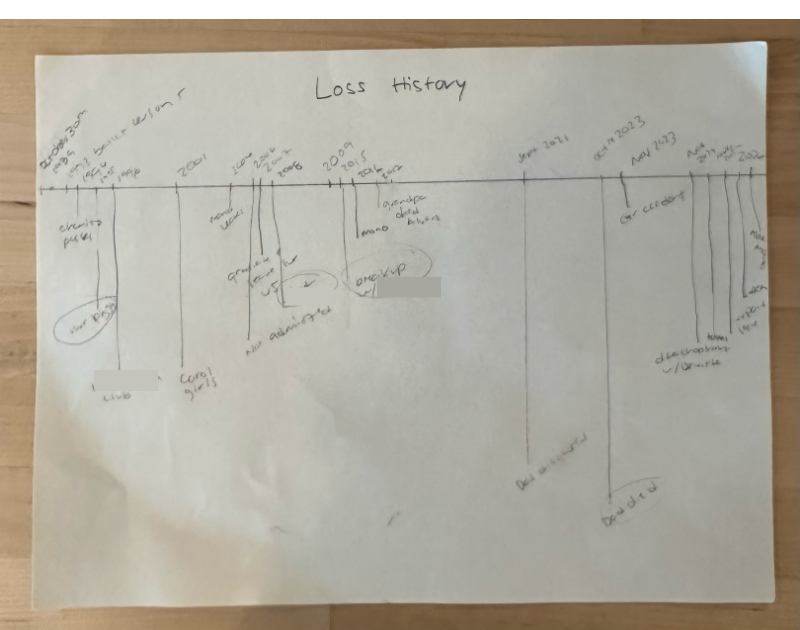 My completed Loss History Graph from Week 3, with personal details obscured
How do you choose which loss to work on in the Grief Recovery Method? (Week 4)
In Week 4 of the Grief Recovery Method, you sit with your Loss History Graph from the previous week, see what else surfaces, and then begin identifying which loss has the most emotional incompleteness. That loss becomes the one you work through in the remaining weeks of the program. The principle is simple: you cannot work on every loss at once, so you start with the one carrying the most undelivered communication.
This week introduces one of the most important concepts in the entire program, which is incompleteness. The handbook describes incompleteness as undelivered emotional communication. So much of what we call grief is actually the weight of things we never got to say, share, ask, or hear. Emotional incompleteness is any undelivered emotional communication, and it is what keeps a loss living inside you long after the event itself has passed.
Once you understand incompleteness, the goal of the work becomes clearer. You are not trying to forget anyone. You are not trying to get over anything. You are trying to complete what was left unfinished, so that you can carry the relationship forward without the weight of the unsaid.
For me, the choice was obvious. The loss of my dad was the biggest one on my graph, and he had also been with me my whole life, which meant the relationship had the most layers and the most that had been left unsaid. So that was where I started.
True to the pattern that made this program feel so supported, Vicki walked me through her own Relationship Graph for her loss before sending me off to do mine. She showed me what the exercise looked like in practice, including the format and the kinds of memories that belong on it. That preview made the next week's work much less intimidating, and it reinforced something I had come to count on. She would never ask me to do something vulnerable without going first.
What is the Relationship Graph in the Grief Recovery Method? (Week 5)
The Relationship Graph is a Week 5 exercise in the Grief Recovery Method where you create a timeline of your relationship with the person or loss you are working on, capturing both the positive memories and the painful ones. While the Loss History Graph from Week 3 focuses on losses across your whole life, the Relationship Graph zooms in on a single relationship and asks you to look at the full picture, the good and the hard, with honesty.
This was a very healing exercise for me. I mentioned earlier that one of the hardest parts of my grief was that when I dreamt about my dad or thought about him, my mind kept returning to the difficult moments and the time when he was sick. The Relationship Graph forced me to slow down and remember everything else. All of the great memories. The funny ones. The ordinary ones. The painful ones, too. By the time I was done, I could see the whole arc of our relationship in front of me, not just the ending.
The purpose of this graph is to set you up for completion in the weeks that follow. The handbook is clear about what completion actually means, and I think this is one of the most important distinctions in the whole program. Completing a loss is not the same as forgetting your loved one. You are completing your relationship to the pain caused by the loss, and you are completing anything that was left unfinished. Your relationship itself remains. Relationships are physical, emotional, and spiritual, and even when the physical part is over, the emotional part is still very much alive. This week is about doing honest work on the emotional part.
One thing the program emphasizes that I really appreciated is honest portrayal. We see so many fantastical versions of grief in movies and TV, where the relationship gets cleaned up after the person dies and everything they did becomes beautiful. Real life is more complicated than that. Being honest with yourself about the good, the complicated, and the hard moments is what makes completion possible. If you only put the highlight reel on the graph, you are not actually completing anything. You are just curating.
The handbook also points out that you can have unfinished emotions tied to hopes, dreams, and expectations, not just to events. That hit me. Some of what I was carrying was about things that never happened, futures my dad and I would not get to have, milestones he would not see. Naming those as part of the work, alongside the actual memories, made room for grief I had not even known how to articulate.
So I did my Relationship Graph for my dad. There were a lot of great moments. There were also a lot of tough ones. Acknowledging both was the point. It validated the complexity of what I was feeling, and it made sense of why I had been carrying so many competing emotions for so long. Of course it had been hard to hold all of that at once. The graph gave me a place to put it.
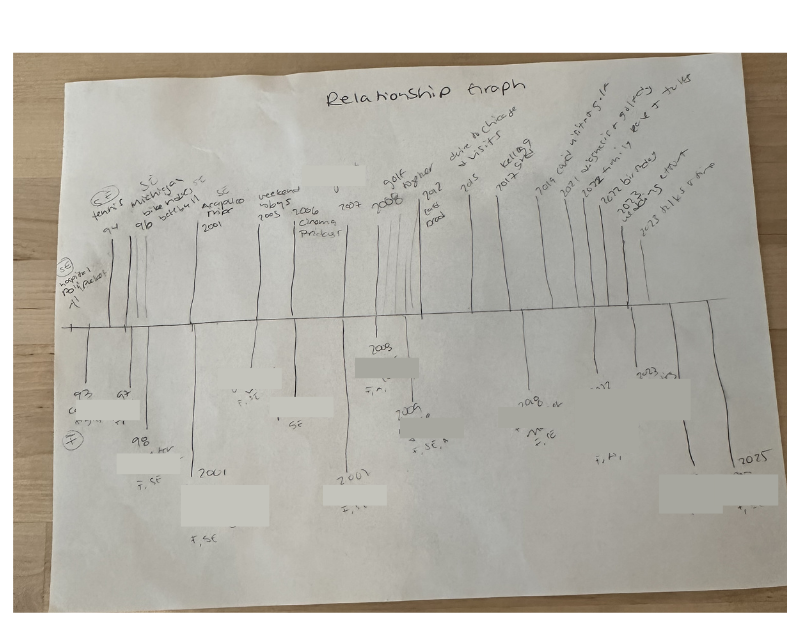 My completed Relationship Graph from Week 5, with personal details obscured
How does forgiveness work in the Grief Recovery Method? (Week 6)
In Week 6 of the Grief Recovery Method, you take your Relationship Graph and go through each item, noting whether it relates to an apology, a forgiveness, or a significant emotional statement. The goal is to identify the undelivered communication tied to each memory, so you can begin to release it. Importantly, this work is not about telling the other person anything. Forgiveness and emotional processing happen on your end, for your sake.
The program draws a clear distinction between forgiving and condoning, and that distinction was one of the most useful pieces of language I picked up from the entire course. Forgiveness is giving up the hope of a different or better yesterday. Condoning is treating something as trivial, harmless, or of no importance. You are not saying that what happened was okay. You are releasing yourself from the weight of wishing it had been different.
This was the most cathartic week of the program for me. I felt grief come through in a way I had not felt before. I cried so much, and there is a kind of crying that happens with grief that feels different from any other kind. It is visceral. Guttural. You feel it at the bottom of your soul, and it sobs through you. I went through my entire Relationship Graph and, for each item, I wrote out what I wanted to apologize for, what I wanted to forgive my dad for, and the significant emotional statements I wanted to make.
I was most surprised that I cried hardest with the apologies. I had assumed it would be the forgiveness that broke me open, but the apologies clearly held things I had been bottling up for a long time and had never been able to say. The forgiveness was also cathartic, just in a different way. My dad and I had a really close relationship, but he was not a perfect person, and there were things he did that hurt me and my family. Putting that on paper, with the perspective to say "I know I cannot change it, but I forgive you. I understand you had different contexts, experiences, and learnings, and I forgive you," was freeing in a way I did not expect.
The significant emotional statements were where I got to live through the joyful, happy moments and thank my dad for them. After acknowledging the hard parts, it was so meaningful to also acknowledge how much he showed up for me, how sweet he could be, how much time he spent with me, and how loved and valued he made me feel. Taking the time to say all of that, in writing, mattered.
I wrote twelve pages, front and back, by hand. I had a picture of him up while I wrote. Maybe it sounds silly to say out loud, because I know he is not here, but it really did feel like I was finally telling him things I had not been able to tell him before. I felt lighter after. There was so much I had not said, so much I had not gotten off my chest, and the page gave me somewhere to put all of it.
What is the completion letter in the Grief Recovery Method? (Week 7)
The completion letter is a Week 7 exercise in the Grief Recovery Method where you take everything you identified in your Relationship Graph from the previous week and turn it into a single letter to the person you are grieving. The letter brings together your apologies, your forgivenesses, and your significant emotional statements, and it ends with goodbye. You are not saying goodbye to the relationship. You are saying goodbye to what is incomplete.
This distinction is one of the most important pieces of the entire program, and it is worth saying clearly. When you finish the letter with goodbye, you are saying goodbye to the pain you associate with the relationship, to any unmet hopes, dreams, or expectations, and to the unrealistic expectation of getting something from someone who could not or would not give it. You are not saying goodbye to the person. You are not saying goodbye to your love for them. You are signaling the end of the unfinished communication, not the end of the relationship.
I want to be honest about how this felt. When I got to the end of the letter and had to write goodbye, I hesitated. There is something about putting that word on the page that makes the work feel real in a way that nothing else in the program quite did. I sat with it, and then I wrote it.
The other piece the program emphasizes is reading the letter out loud. You do not just write it. You read it. Vicki listened to me read mine, and that mattered. There is a difference between writing your truest things in private and saying them aloud while another person witnesses you. The witnessing is part of what makes the completion land.
Going through the letter put everything from the previous weeks into one place. The apologies for what I had or had not done. The forgivenesses, which is to say ceasing to feel resentment and acknowledging that what happened will not change. The significant emotional statements thanking my dad for the moments that made me feel loved, the moments I had not had a chance to thank him for while he was here. By the time I read the last line, I felt something settle.
This week was the culmination of everything that came before. The Loss History Graph showed me the weight I had been carrying. The Relationship Graph helped me see my dad and our relationship honestly. The apology, forgiveness, and significant emotional statements work helped me name what was unfinished. The completion letter gathered all of it into one place, gave it to my dad in the way that was still available to me, and let me say goodbye to the parts of it that had been weighing me down. The relationship is still here. The pain has loosened its grip.
What happens in Week 8 of the Grief Recovery Method?
Week 8 of the Grief Recovery Method is the final session, where you check in on how you are feeling after the completion letter, address anything additional that has come up, and learn how to use these tools on your own going forward. If new things surface after you finish the completion letter, you write what is called a P.S., which is a short follow-up letter that captures whatever else needs to be said.
By this point in the program, you have the tools. You know how to build a Relationship Graph for any loss, you know how to identify what is incomplete, and you know how to write a completion letter. Week 8 is partly about making sure you understand that this is portable. The Grief Recovery Method is not something you only do once with a specialist. It is a framework you can return to for any loss in your life, and you will have many losses in a lifetime, big and small.
I plan on using these tools again. There are other relationships and other losses on my Loss History Graph that I now know how to work through, and that is one of the most valuable things I am taking away from the program. I am not just walking out lighter from the work I did with my dad. I am walking out with a method I can use for the rest of my life.
Who is the Grief Recovery Method for?
The Grief Recovery Method is for anyone dealing with any kind of loss, not only the death of a loved one. The handbook and the program both make clear that grief applies to moves, divorces, breakups, career changes, health changes, estrangements, and any other end or change in a familiar pattern of behavior. If you are carrying something that feels unfinished, the method gives you tools to work through it.
In my experience, this program is especially valuable if you have been telling yourself you are fine while your body is telling you something different. The anxiety, the panic, the disrupted sleep, the dreams that keep returning to the hardest moments. Those were the signs that I was not as processed as I thought I was. If any of that sounds familiar, the Grief Recovery Method is worth a serious look.
I would also say it is for people who want structured, active grief work rather than open-ended talk therapy. Both have their place, and they are not in competition. But the Grief Recovery Method gives you a clear path with weekly readings, exercises, and assignments. If you are someone who wants to actually move forward and have specific tools to do it with, the structure is part of why this works. If a more open-ended approach feels like a better fit for you right now, there are other grief specialists in our directory worth exploring.
One last thing worth saying. The Grief Recovery Method is a strong framework, and it can be facilitated by any certified Grief Recovery Specialist. My experience was shaped specifically by working with Vicki at Freedom From Grief. The method gave me the structure. She gave me the safety to actually use it. If you are considering this work, the practitioner you choose matters as much as the program itself. Look for someone whose presence makes you feel like you can be honest, because honesty is what the work asks of you.
Is the Grief Recovery Method worth it?
The Grief Recovery Method was worth it for me, and I would highly recommend it to anyone dealing with any type of loss. It has been one of the most helpful things I have ever done. I am sleeping better. I feel happier. I feel much happier about my relationship with my dad. I am able to think back on him with a lot of love and a full heart, instead of feeling pulled back into the hardest moments.
The work is not easy. There were sessions where I cried so hard my whole body shook, and there were exercises that brought up things I had been carrying for years without knowing it. If you are looking for something gentle and surface-level, this is not that. But if you are willing to do the work, the relief on the other side is real, and it lasts.
What made the experience particularly meaningful for me was working with Vicki at Freedom From Grief. Her warmth, her willingness to be vulnerable first, and her genuine commitment to listening rather than fixing made the harder weeks possible. The Grief Recovery Method is a strong program on its own, and it is even stronger with practitioners who hold the space the way they do.
If you are considering it, I would gently encourage you to go for it. You can learn more about Vicki and the program through Freedom From Grief's profile in Good Grief's expert directory or directly through Freedom From Grief.
Frequently asked questions about the Grief Recovery Method
Closing note
If you have made it this far, thank you for reading. Writing this has been its own form of completion, and I hope something in it is useful to you, whether you are considering the program yourself, supporting someone who is grieving, or just trying to make sense of your own loss. Whatever you are carrying, you do not have to carry it alone, and you do not have to carry it forever.